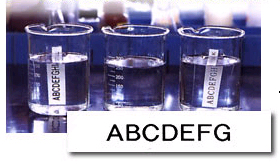
 The
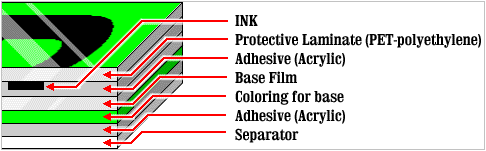
laminated tape structure consists of six layers
of material that are surprisingly thin, yet strong.
Unlike most label-makers on the market, P-touch
labels print on the underside of the laminate, sandwiching
text between two layers of film, making the characters
virtually indestructible. The
laminated tape structure consists of six layers
of material that are surprisingly thin, yet strong.
Unlike most label-makers on the market, P-touch
labels print on the underside of the laminate, sandwiching
text between two layers of film, making the characters
virtually indestructible.
Find out more about how we've put P-touch labels
to the test...
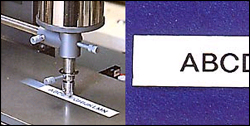 Abrasion
Resistance Abrasion
Resistance
After 50 round-trip passes with a 1kg weighted
sand eraser, Brother laminated tapes only came
up slightly scratched with the characters underneath
completely unaffected.
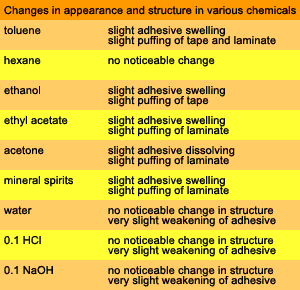 Chemicals and Water
Having bathed Brother laminated tapes in a variety
of materials for two hours, they still managed
to remain affixed to their surfaces with little
damage. Even chemical spills, with a quick wiping,
result in minimal damage.
 Security
Tape Security
Tape
This tape has a special adhesive so when the label
is peeled off it leaves a checkerboard pattern.
Use it for labels that must not be peeled off
such as company assets.
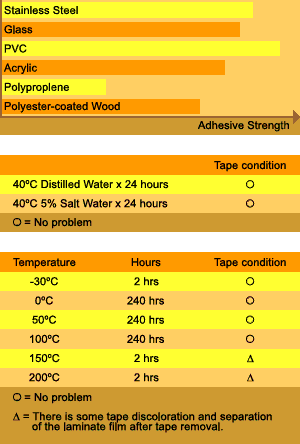 Laminated
Tape Adhesive Strength Laminated
Tape Adhesive Strength
Brother laminated tapes will adhere to almost
any surface including: stainless steel, glass,
PVC, acrylic, polypropylene, and polyester-coated
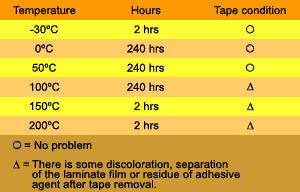
wood. The tapes stand up to hot, cold, and humid
conditions, and even adhere better when heated.
Smooth, rough, flat or rounded surfaces are no
problem for Brother laminated tapes.
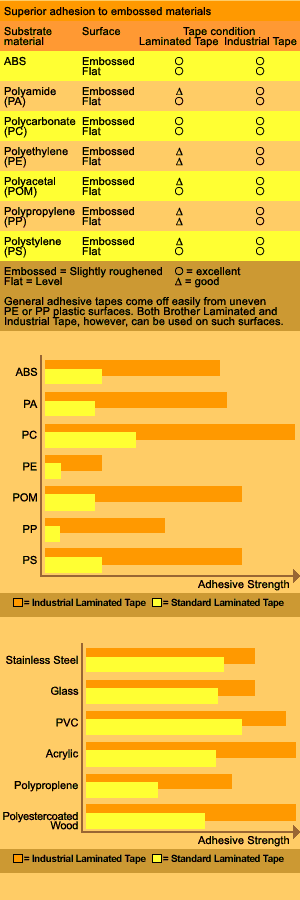 Laminated Industrial Tape
Adhesive Strength
Laminated Industrial Tape
Adhesive Strength
Our industrial tapes have twice the adhesive strength
of our regular tapes, allowing it to be used on
a much wider range of materials and under more
extreme conditions.
Fade Resistance
Brother laminated tapes were attached to coated
metal plates, and placed in a fade-inducing chamber
at 83¼C for 100 hours to simulate a year in a
sunny environment. Then they were placed in a
chamber at 63¼C for 400 hours to simulate a year
in, not only heat and light, but water as well.
Only yellow tapes showed significant signs of
fading while the others showed little sign of
fading to the eye.
Dielectric Strength
In tests performed by Brother, white P-Touch tapes
with black characters began to lose their electric
resistance at an applied voltage of 8kv, and lost
their resistance entirely at 11kv. Most other
color variations will have the same resistance.
|